5 Surprising Truths About Longevity That Challenge Everything You Knew
In our modern world, we are drowning in an abundance of information about health and longevity. From diet trends and workout fads to the latest "biohacking" supplements, the sheer volume of advice can create more stress than health. It’s easy to feel overwhelmed, wondering which lever is the most important to pull for a longer, healthier life.
This article is designed to be a filter. We’ve cut through the noise and distilled the research to bring you five of the most impactful, surprising, and counter-intuitive truths from the science of longevity. These are the concepts that challenge conventional wisdom and shift the focus from fleeting trends to foundational principles.
--------------------------------------------------------------------------------
1. You’re Measuring Your Biggest Health Risk All Wrong
For decades, the standard lipid panel has been the go-to tool for assessing heart disease risk, with a laser focus on one number: LDL-cholesterol, or LDL-C. We've been taught that this "bad cholesterol" is the primary villain in the story of cardiovascular disease. But this is a dangerously incomplete picture.
Think of it this way: cholesterol is the cargo, and lipoproteins are the boats that carry this cargo through your bloodstream. A standard test measures the total weight of the cargo (LDL-C). This seems logical, but what if you have a huge number of very small, light boats? Your total cargo weight might look low, but you have a traffic jam of boats in your arteries.
This is where apolipoprotein B (apoB) comes in. Every single potentially artery-clogging lipoprotein particle—the boats—has exactly one apoB molecule on its surface. Therefore, measuring your apoB level is like counting the actual number of boats. It’s a direct measurement of the particle concentration responsible for atherosclerosis. The reason this number is so critical is simple: atherosclerosis is a game of probability. A greater number of apoB-containing particles leads to a greater number of them entering and getting trapped within the artery wall. As the source material puts it, it's a stochastic process: "the more shots on goal (particles hitting the artery wall), the more chances of goals (particles getting through the cracks)."
Sometimes, the amount of cargo (LDL-C) and the number of boats (apoB) don't agree. This is called discordance. Large-scale studies like the Framingham Offspring and MESA cohorts have shown that when these two numbers are discordant, cardiovascular risk follows the particle count (apoB), not the cholesterol level. A person with "low" LDL-C but a high apoB is at high risk, and they may not even know it. This simple shift in measurement moves us from a potentially misleading proxy to a more direct and accurate measure of risk, empowering you to have a far more informed conversation about your long-term cardiovascular health.
"if you don’t know your apoB level, you are not fully taking advantage of the tools at our disposal to estimate your risk of cardiovascular and cerebrovascular disease."
--------------------------------------------------------------------------------
2. The One Part of Your Health That Can Actually Improve With Age
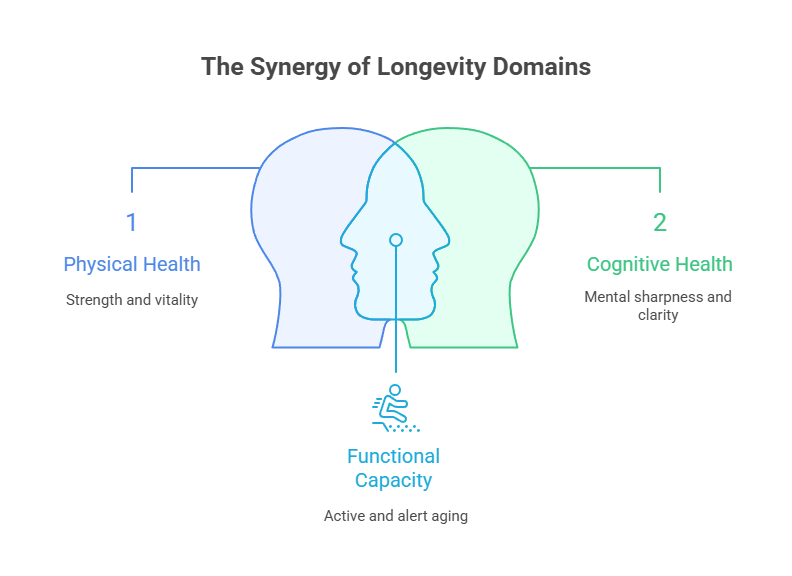
When we think about aging, we often picture a steady, inevitable decline. Longevity expert Dr. Peter Attia frames healthspan—the quality of our years—as having three key components: physical, cognitive, and emotional health.
For the first two, the trajectory is unfortunately clear. As Attia candidly reflects, he is "completely past [his] prime physically and cognitively" and will never again reach the physical or mental peaks of his youth. While we can work to slow the rate of decline through exercise and other interventions, we cannot reverse the tide completely. Our physical strength and raw intellectual horsepower will diminish over time.
But emotional health is different. Unlike its counterparts, emotional well-being does not have to decline with age. In fact, for many, it can dramatically improve. Research suggests that emotional health often follows a U-shaped curve, hitting a low point in one's late 40s before gradually rising again through the later decades of life. This is the one domain where we have a genuine opportunity for growth as we age.
"I can be emotionally better off in a decade than I am today, and I am certainly better off today than I was a decade ago."
This is a profoundly optimistic truth. It reframes the pursuit of longevity from a purely defensive battle against physical decay to include the active, intentional cultivation of our inner world. Through practices like mindfulness, meditation, and therapy, we can build emotional resilience and well-being that makes our longer lives richer and more meaningful.
--------------------------------------------------------------------------------
3. To Build More Muscle, The Surprising Answer Might Be… Less Food Variety?
The advice to "eat the rainbow" is a cornerstone of mainstream nutritional guidance. The logic is sound: a wide variety of colorful plants provides a broad spectrum of vitamins, minerals, and phytonutrients. But what if the goal isn't general wellness, but something highly specific, like maximizing muscle gain for elite athletes like 300-pound strongmen who might need to consume upwards of 8,000 calories a day?
Enter the Built Different Diet. Its core principle is shockingly counter-intuitive: radically limit food variety. The diet focuses on a small number of nutrient-dense, easily digestible foods, with protein and white rice forming the foundation.
The rationale is purely functional. For a massive athlete, consuming thousands of calories from a wide variety of foods—especially high-fiber, high-FODMAP vegetables like broccoli and onions—can lead to significant digestive distress, bloating, and gas. This discomfort makes it physically difficult to eat enough. The diet focuses on a base of easily digestible, micronutrient-rich foods like spinach and carrots. Once those needs are met, body composition is adjusted by increasing calories almost exclusively from the two core performance foods: protein and white rice.
This approach has significant and obvious downsides. It is highly restrictive, lower in fiber, and thus could negatively impact gut microbiome diversity. Furthermore, a high intake of red meat runs contrary to most public health guidelines.
The takeaway isn't to recommend this diet for the average person. Rather, this extreme example powerfully challenges the universal dogma of "variety is always best." It forces us to think critically about the specific goal of our diet and illustrates that optimal nutrition is highly context-dependent. Sometimes, for a very specific outcome, less is more.
--------------------------------------------------------------------------------
4. The Alarming Math of Age-Related Weakness
We talk a lot about cardiovascular fitness for longevity, but we often neglect an equally critical pillar: strength. As we age, we all experience sarcopenia, the progressive loss of muscle mass and strength. The statistics are stark: studies show that after the age of 50, we can expect a strength loss of 1% to 4% per year.
That may not sound like much, but the power of compounding makes this decline devastating over time. A 2% annual loss means that by age 75, a person could have lost nearly 40% of their strength from their peak at age 50. This isn't just about athletic performance; it's the mathematical blueprint for the loss of independence. The ability to perform simple tasks we take for granted—getting up from the floor, carrying groceries, placing a bag in an overhead bin—is a direct function of strength. Building a reserve is not vanity; it is a strategy to preserve agency in our later decades.
"If you have the aspiration of kicking ass when you're 85, you can't afford to be average when you're 50."
This insight reframes strength training entirely. It is not an activity of vanity pursued by the young. It is an essential, non-negotiable tool for longevity. The goal of training in your 40s, 50s, and 60s is to build a "reserve" of muscle and strength. By starting from a much higher peak, you can slow the inevitable decline and ensure that you maintain the physical capacity to do the things you love for your entire life.
--------------------------------------------------------------------------------
5. That "Healthy" Fasting Habit Could Be Costing You Muscle
Time-restricted eating (TRE), also known as intermittent fasting, has exploded in popularity as a strategy for weight loss and metabolic health. The 16:8 protocol—fasting for 16 hours and eating within an 8-hour window—is particularly common. But a landmark study on overweight and obese individuals (average BMI of 33), a population often already metabolically challenged, revealed a surprising and deeply concerning potential downside.
The TREAT trial was a 12-week randomized controlled study that compared a 16:8 TRE protocol to a standard three-meal-a-day schedule. The results were shocking: in the group assigned to TRE, a staggering 65% of the total weight lost was lean mass, not fat. For context, lean mass loss during weight loss typically accounts for about 25%.
This highlights the crucial difference between a treatment's efficacy (how it works under perfect, controlled conditions) and its effectiveness (what happens when you simply prescribe it in the real world). This is where efficacy collides with real-world effectiveness. The researchers suggest the muscle loss was likely due to inadequate protein intake and a decrease in physical activity. Prescribing an 8-hour eating window without also prescribing adequate protein intake and continued resistance training is a recipe for failure. The tool itself might work under ideal conditions, but the prescription failed because it overlooked these non-negotiable foundations.
This is a critical cautionary tale. No single dietary strategy is a magic bullet. Protecting lean muscle mass through adequate protein intake and consistent resistance training is non-negotiable, especially when you are restricting calories or shortening your eating window.

--------------------------------------------------------------------------------
Conclusion: The Real Secret
If there’s a single secret to longevity, it's that there are no simple secrets. The most impactful truths are often nuanced, challenging the black-and-white rules we're often sold. They require us to look beyond fleeting trends and focus on foundational principles: measuring risk correctly, cultivating emotional health, understanding nutritional context, building a reserve of strength, and always, always protecting our muscle.
The good news is that the path is clear, even if it's not always easy. Want to learn how to fit this into your lifestyle? Send us an email on our contact page!